Suggestion review process

How to evaluate employee suggestions in 5 clear decisions.

When a suggestion gets a nod and nothing else, the employee stops suggesting. Use these five decisions so every review ends with an owner and a next step.

Illustration of an Idea Manager reviewing a four-column suggestion board.

Start with one example

Every review should end with a decision someone can act on.

An operator suggests a fixed, marked spot for a shared gauge. You reply “Good idea” and move on. Two weeks later, nobody knows who checks the spot or what happens next.

A good review records four things: the problem, the decision, the responsible team and the next action. The five decisions below help you write that down. Use them in your notes and replies; they sit alongside the board’s columns and are not extra statuses in IdeaKanban.

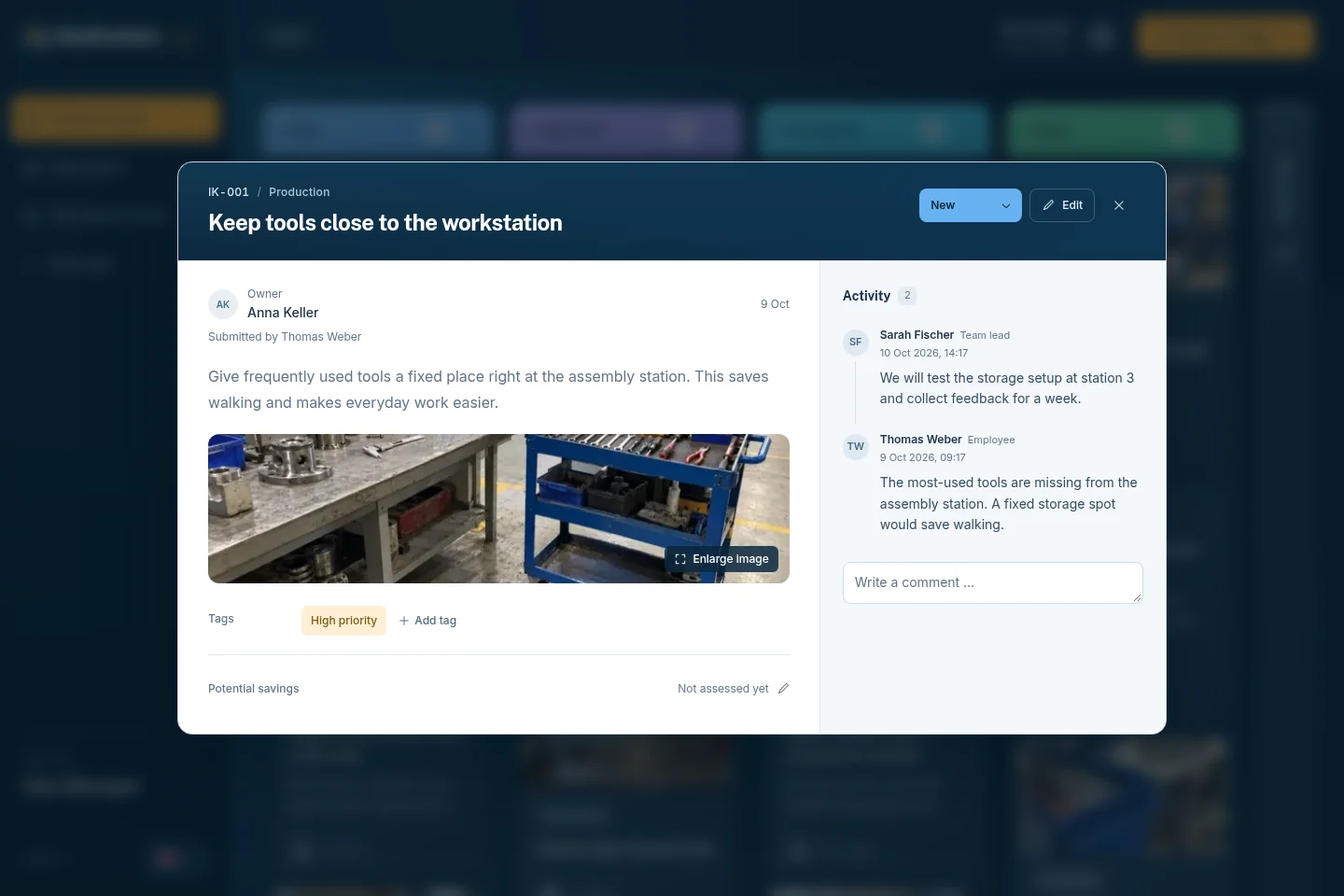
Actual IdeaKanban demo suggestion showing a tool-storage photo, Production department and activity.
An idea in detail: photo, responsible department and every update in one place.

How to evaluate employee suggestions: 5 decisions.

Decision 1

Ask one clarifying question

Use it when: You can't yet tell what happens, where it happens or what the employee proposes.

Example: Which station uses the gauge, and where does the next operator look for it?

Next action: Ask one specific question and keep the idea in review. Don't ask the employee for a business case.

Decision 2

Approve a small test

Use it when: The problem is clear and a team can try a small change.

Example: Production tests one marked spot for the gauge at station 3, and both shifts use it for two weeks.

Next action: Name the department, the next action and what they will check. Approval starts the handover; it doesn't finish it.

Decision 3

Decline with a reason

Use it when: The proposal conflicts with a requirement or can't work the way it is suggested.

Example: We can't remove the required protective insert. Logistics will check approved alternatives for the empty space.

Next action: Give the reason through your agreed feedback route. Keep the decision separate from any follow-up action.

Decision 4

Link it to a duplicate

Use it when: Another suggestion or a running test already covers the same work.

Example: Production is already testing a new gauge location. We'll add your shift's input to that test.

Next action: Record which idea it belongs to and tell the employee where to follow it. You do this by hand; ideas don't merge automatically.

Decision 5

Defer to a set date

Use it when: There is a real reason to wait, such as a planned layout change or another team's work.

Example: We'll revisit the shelf position after the station move. The coordinator confirms the date with Production.

Next action: Name who follows up and when. 'Later' on its own is not an action.

Approval starts the handover.

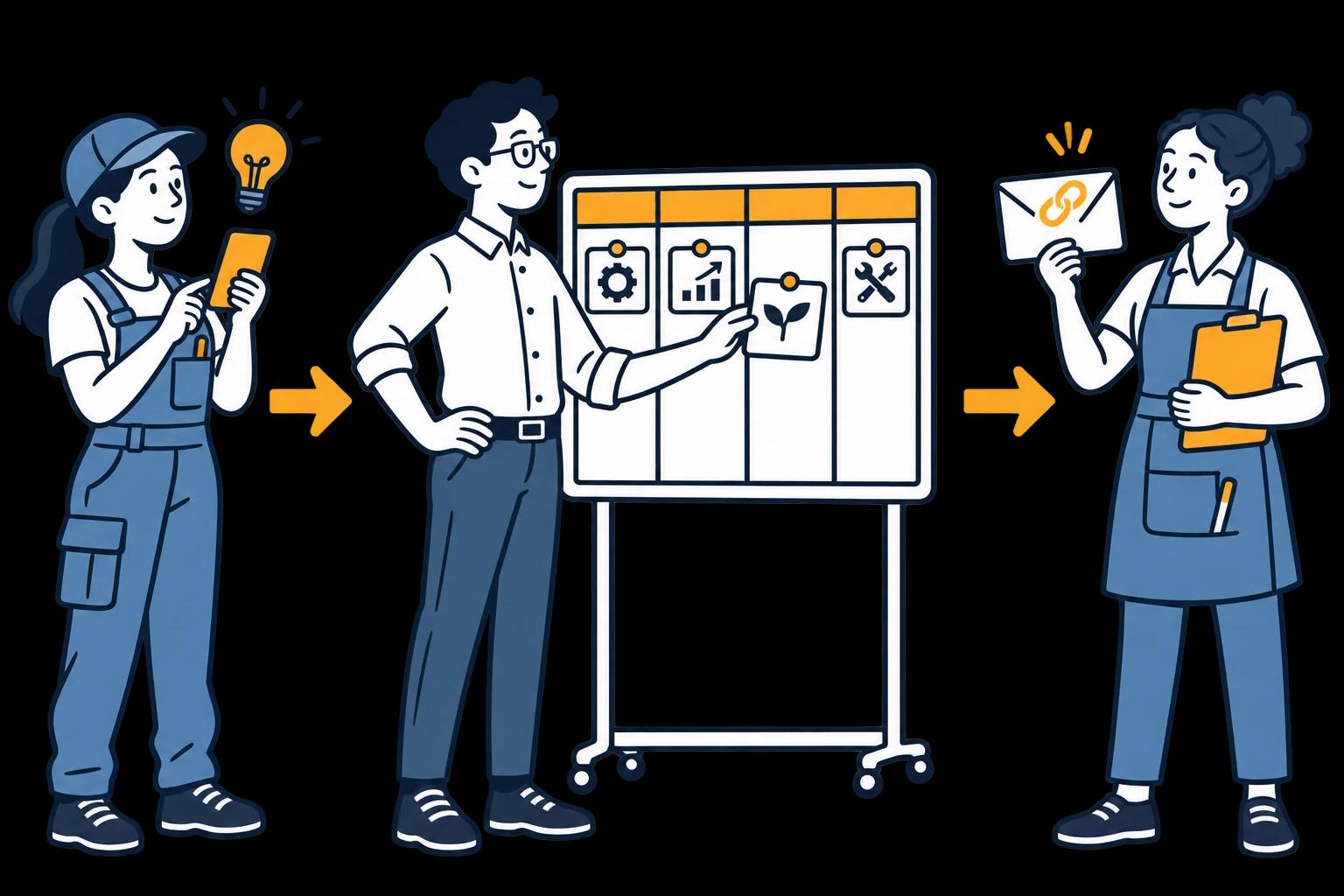
Illustration of an employee submitting an idea, a coordinator reviewing a board and a department colleague holding an update link.
Three jobs in the process: submit, manage and update assigned work.

From reviewer to team

Name the team, the test and the check.

For the gauge idea, the handover could read: Production tests one marked spot with both shifts at station 3. The check: can the next operator find and return the gauge without asking around?

Now the department has something concrete to accept and report on. Set a review date the named people agree to, not a deadline nobody signed up for.

A four-point agenda for your review meeting.

  1. New ideas

    Read what came in. Ask for the one missing detail that blocks a decision, not for a full proposal.

  2. Approved work

    Check who accepted the next action and whether the department has what it needs.

  3. Stuck ideas

    Look at the actual blocker. Agree the next review date and who follows up.

  4. Results and replies

    Check what happened after implementation, then tell the employee or team the outcome.

Close every decision with a reply.

Illustration of colleagues discussing the result of a workplace improvement.
Keep the outcome and the feedback connected to the original suggestion.

Close the loop

A no or a not-yet still needs an explanation.

People need the reason for the decision and whether anything else will happen. Name the observation, constraint or dependency instead of sending a generic thank-you.

The six response examples cover received, question, approved, declined, delayed and done. Keep your reply consistent with the decision you recorded.

Sources and approach

The decisions, agenda and gauge example come from the IdeaKanban team, not from a customer case. ASQ’s PDCA guidance supports trying a change on a small scale and checking the result. CIPD’s employee voice guidance explains why managers need to listen and act on feedback.

Try it with your team

Give your next idea a place to start.

Create your own workspace and try Business free for 30 days. No credit card needed to start.

Try interactive demo